
The short answer
Replacing a furnace usually makes sense when it's unsafe, keeps breaking down, or has never heated the house well. If the problem is a single part, a repair may be all you need. We inspect the whole heating system first, then give you clear written options, including gas furnaces and heat pumps, based on what your home actually needs.
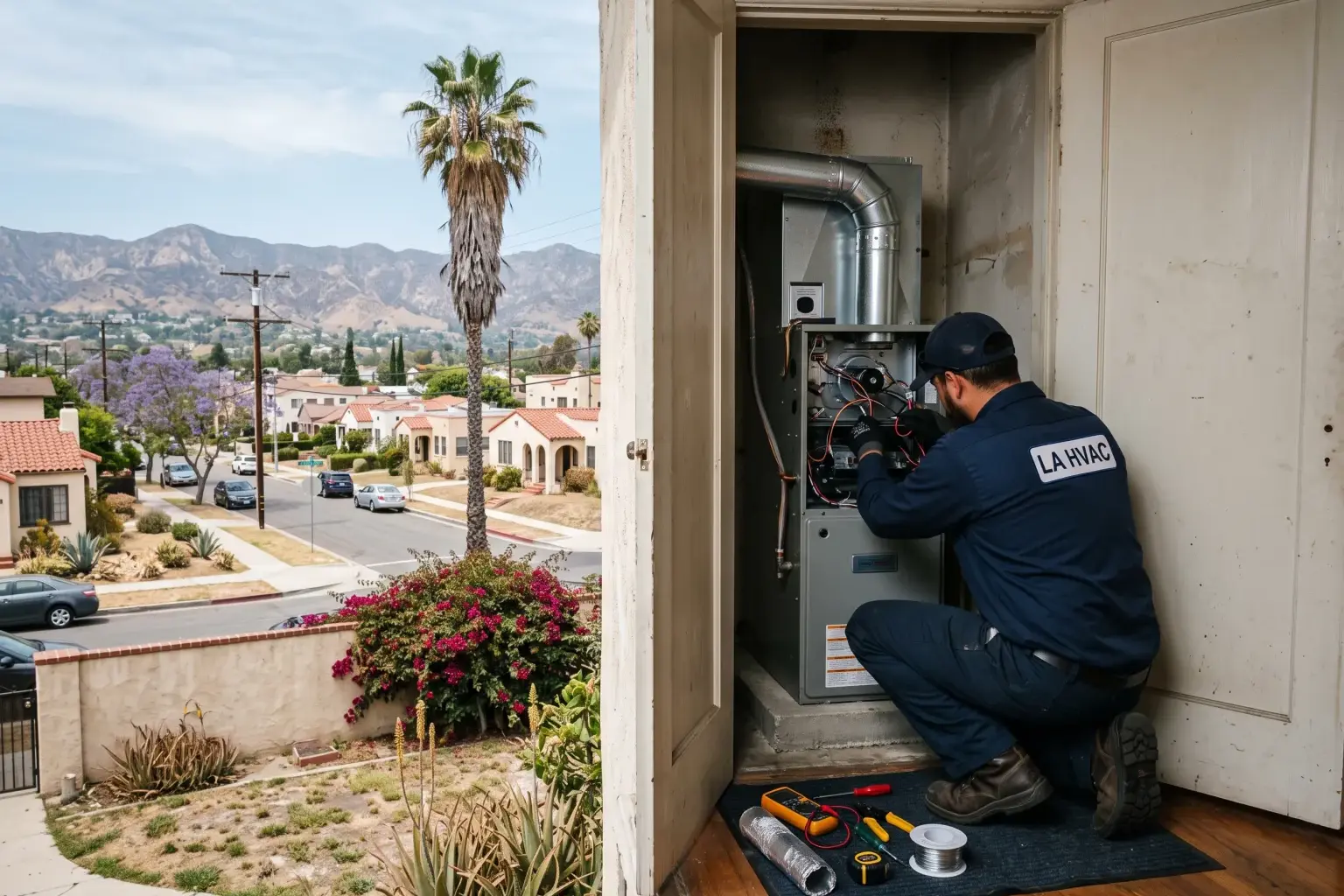
Most furnaces in Canoga Park and the rest of the west San Fernando Valley sit quietly in a closet, attic, or garage for most of the year, then have to work hard on cold winter nights. When a furnace starts failing, it isn't always obvious whether to fix it or replace it. This page explains how we handle furnace installation for homeowners in Canoga Park, Winnetka, West Hills, Woodland Hills, Reseda, and Chatsworth. It covers the signs that point toward replacement, what our technicians inspect before recommending anything, the options you have, what drives the cost, and what to expect from your first call to the final test run.
Signs You May Need a New Furnace
A furnace rarely fails all at once. It usually gives warnings over a season or two. Los Angeles winters are mild, so a weak furnace can keep running for a long time before anyone notices how poorly it's performing. Watch for these signs:
One of these signs on its own doesn't always mean you need a new furnace. A noisy blower or a bad igniter is often a simple repair. What matters is the overall condition of the unit, which is why we inspect before we recommend anything.
- Rooms that never reach the thermostat setting, or air from the vents that feels lukewarm
- The same part failing again, or repair calls that have become a yearly event
- Burner flames that look yellow or flicker instead of burning steady blue
- Rust, cracks, or soot on the furnace cabinet or around the vent connection
- Rattling, banging, or squealing noises that weren't there before
- Gas bills climbing even though your habits haven't changed
- Short cycling, where the furnace turns on and off every few minutes
- A carbon monoxide alarm going off. Get everyone out of the house and call 911 or your gas company before calling us.
What We Check Before Recommending Anything
Before we quote a new furnace, we look at the whole heating system, not just the furnace itself. A new furnace connected to leaky ducts or the wrong venting won't perform the way it should.
We also ask how the house actually feels. Temperatures in Valley homes can vary a lot from room to room. We size the new furnace based on your house, not just the label on the old unit. That way you don't end up with a furnace that's too big or too small.
- Heat exchanger condition, including visible cracks or corrosion
- Burners, igniter, flame sensor, and gas valve operation
- Venting and flue connections, and whether the existing vent will work with a new unit
- Blower motor and airflow through the system
- Ductwork condition and sizing, and obvious leaks at the connections
- Thermostat wiring and whether it will work with new equipment
- Combustion air supply and clearance around the unit
- Filter rack, return air sizing, and overall cleanliness of the system
Repair or Replace: Your Options
If the heat exchanger is sound and the problem is a single part, repair is usually the sensible choice, and we'll tell you so. Replacement makes more sense when there are safety concerns, repeated breakdowns, parts that are hard to find, or a system that has never heated the house well.
When replacement is the right call, you generally have three options. The first is a standard gas furnace that matches your existing setup. The second is a higher-efficiency gas furnace, which may need changes to the venting. The third is an electric heat pump, which heats and cools with one system. Heat pumps work well in our mild climate, where winter nights rarely push them to their limits.
Before you choose a gas furnace, you should know about South Coast AQMD Rule 1111. This rule limits nitrogen oxide (NOx) emissions from natural-gas furnaces sold and installed in the Los Angeles region. The district has been amending the rule toward zero-emission requirements, and it sets and revises the compliance dates. That's why we check the current version of the rule whenever we plan a furnace replacement.
What Affects the Cost of a Furnace Installation
We price every installation after seeing your home in person. The same furnace can cost very different amounts to install in two houses on the same street. The main factors are:
Rebates can cover part of the cost, but which ones you can get depends on where you live. LADWP residential electric customers can apply for rebates on qualifying heat pump systems. The amount depends on the unit's SEER2 and HSPF2 efficiency ratings. You file the application after the equipment is purchased and installed, and you must file within 12 months of purchase. Many homes outside the City of Los Angeles get their electricity from Southern California Edison instead, so the rebates available to you depend on your utility. We confirm the current offer before including it in a quote. The federal Energy Efficient Home Improvement Credit (25C) applied only to qualifying heat pumps placed in service before December 31, 2025, so it isn't available for new installations.
- Type of equipment: standard gas furnace, high-efficiency gas furnace, or heat pump
- Size and efficiency rating of the new unit
- Location of the unit: attic, garage, closet, and crawlspace installs differ in access and labor
- Venting changes, especially when upgrading to a high-efficiency furnace
- Duct repairs, sealing, or changes
- Electrical work, which is more common when switching to a heat pump
- Permits and inspections required by your city
- Thermostat upgrades and add-ons such as better air filtration
How a Visit Works
It starts when you contact us and describe what's happening. We schedule a time, and a technician comes out to inspect your furnace and the rest of your heating system as described above.
After the inspection, the technician explains what they found in plain terms. If a repair makes sense, they'll say so. If replacement makes more sense, you'll get written options that describe the equipment choices and the work each one involves. You can compare them on your own time, without pressure.
On installation day, the crew covers your floors and work areas, then disconnects and removes the old unit and sets the new one. They connect the gas or electrical service, venting, ductwork, and thermostat. Then they start the system and test it. They check for gas leaks, confirm the unit vents safely, measure airflow and temperatures, and make sure the thermostat controls everything correctly. Before leaving, they show you how to run the system and change the filter, and they explain any follow-up inspection your city requires.